跳转到主要内容

This website no longer supports the Internet Explorer web browser.

Microsoft is retiring and will no longer support Internet Explorer.  Please use another web browser to access this website.  

Click here for more details.

Wabtec Corporation Shore Powe r

On the Waterfront: Wabtec ‘Shore Power’ Solutions Charge Up Global Shipping Industry

With ShoreCONNECT and FerryCHARGER, Wabtec meets port demands for safe, clean, reliable, and efficient ‘shore-to-ship’ power transfer

Introduction

Ports are best known as points of embarkation and disembarkation – literally the starting or ending points of a maritime journey. This holds true for both the multi-billion-dollar cruise-line industry as well as for global shipping (80% of world trade by volume is moved by ships). Yet ports are also in the process of becoming something else: charging stations – extensions of the grid.

Driven in part by the global electrification trend, international and regional emissions regulatory frameworks1, and local commitments to operate more sustainably, ports are at the epicenter of a sea change in the maritime industry, one that is helping ports live up to their potential as safe, productive, and efficient hubs of commerce, while also stepping up as a great neighbor to their local communities.

At the center of this shift is Wabtec, a company with a century-plus connection to the world’s most important ports and port operators, a relationship rooted in the successful delivery of innovative and efficient power-transfer solutions.

“Yes, there is a ‘green wave’ in the maritime industry, but port operators aren’t adopting sustainable power solutions solely for regulatory reasons: they are realizing that cleaner ports make good business sense,” offers Olivier Kompaore, Vice President of Charging and Power Transfer at Wabtec. “Port operators don’t have the luxury of pursuing innovation for innovation’s sake. They have to be practical and are looking for solutions that are environmentally friendly and drivers of efficiency, safety, and reliability.

“And they want these solutions delivered by companies who know how to succeed on the waterfront, partners they can trust.”

Wabtec currently supports power-transfer requirements for a wide range of vessels. For cruise liners, container vessels, feeder and bulk carriers, as well as a variety of service ships, the company’s Onshore Power Supply (OPS) products are designed for flexibility, operational safety, and keeping the quay (the port infrastructure) clear for cranes and access gateways. In this world, it’s not the speed of power delivery that matters most, but rather its overall safety and efficiency.

But for ships making brief stops – for example, electric ferries – time is of the essence. The goal here is to complete a charge safely in the shortest window possible, typically 15 minutes or less, while vehicles and passengers exit, and others come on board. Here, too, Wabtec’s power-transfer solutions are emerging as the standard.

With these two distinct flavors of shore-to-ship solutions in mind, let’s take a closer look at each.

Nassau, we have a problem

Consider the cruise ship. These behemoth vessels have grown dramatically in size over the last decades. The largest among them, Royal Caribbean’s Oasis-class vessels, are over 1,000 feet long – comparable to a skyscraper turned on its side – weigh over 200,000 gross tons, and can accommodate over 7,000 passengers on 20 decks!

But there’s a problem. Cruise ships are powered by massive diesel engines. Historically, when these vessels docked, allowing passengers to disembark, they needed to keep their engines running.

Why?

Because these ships operate much like large hotels: while in port, their lighting, HVAC, and refrigeration systems rely on auxiliary engines as power generators. Put another way, cruise liners have kept their engines running to keep the lights on.

Yet every hour a large cruise ship spends at berth with its engine idling releases harmful pollutants into the atmosphere. A single vessel can burn 30,000 liters (~8,000 gallons) of diesel fuel  during an 8-10 hour stay, emitting CO2, NOx, SOx, and particulate matter equivalent to a small city.

And, remember, popular ports don’t just house a single ship at a time. The Nassau Cruise Port in the Bahamas, for example, has six berths and can accommodate 7 cruise ships simultaneously.

Simply put, that’s a lot of pollution.

Working closely with port operators, something it has been doing since the early 1900s through its association with Stemmann-Technik (Wabtec acquired the company as part of its purchase of Fandstan Electric Group Ltd in 2014), Wabtec has taken the lead in OPS solutions. This technology enables ships to plug into the grid while at berth and turn off their diesel engines. As a consequence, emissions are completely eliminated, while noise and vibrations are dramatically reduced.

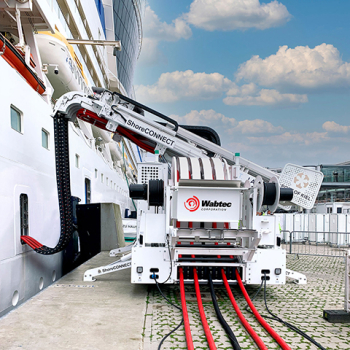
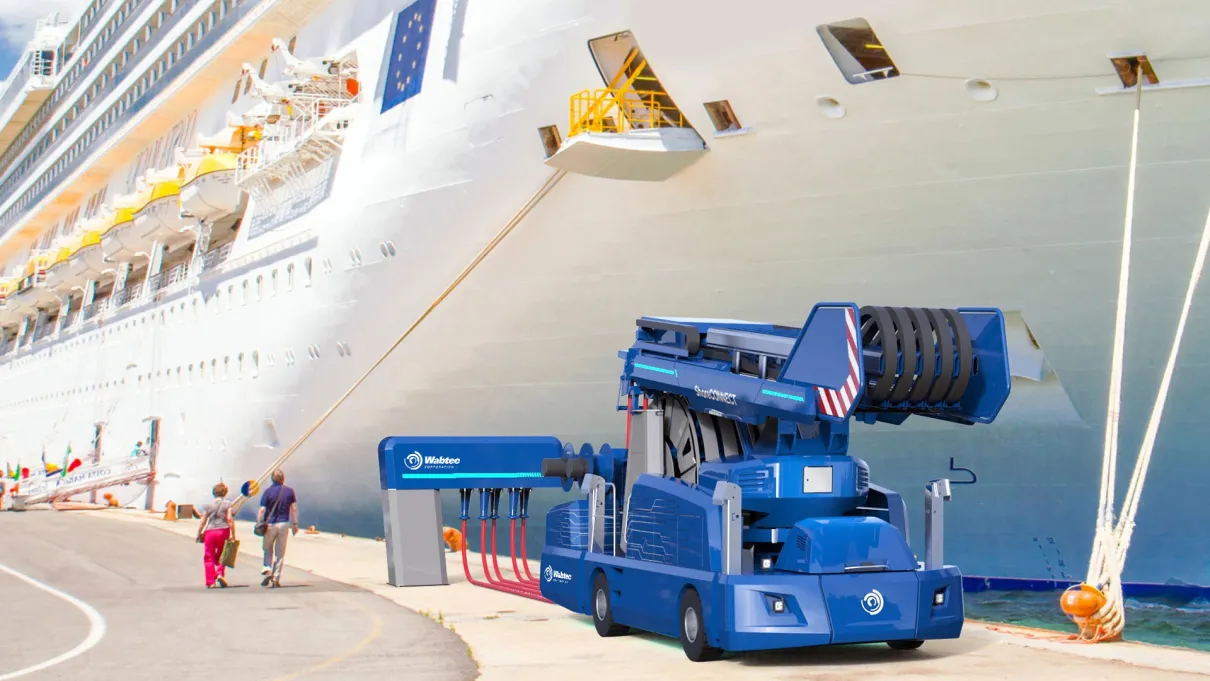
Wabtec’s leading product in this category, ShoreCONNECT, acts as the interface between the harbor’s power supply and the vessel.

图像
Wabtec ShoreCONNECT

“The idea in itself is simple: how best to plug a port’s power source into the ship’s electrical ‘socket’ while at berth, but the optimal execution of that feat draws on decades of power-transfer skills, from developing port-side ‘junction boxes’ to designing and manipulating the heavy cables needed to make the connection,” says Kompaore.

Customers, including the Port of Nassau, are flocking to this solution not only because it works, but because of how it works.

“ShoreCONNECT is full of innovations that appeal to port operators’ overriding mandate for flexibility, safety, efficiency, and reliability,” instructs Jan Frieling, ShoreCONNECT engineering lead. “Wabtec’s shore power solutions come with an advanced mechanical arm that handles the heavy cables with great dexterity, enabling one port-side crew member to make the connection, whereas it used to take four.

“In addition, the product comes in different configurations, one stationary for a fixed docking procedure, the other mobile, so that the cable management system (CMS) can be moved easily across the dock to meet ships wherever they berth. ShoreCONNECT also compensates for tidal range – this is the ocean we are talking about, a moving target! – and is designed to protect against flooding.”

图像
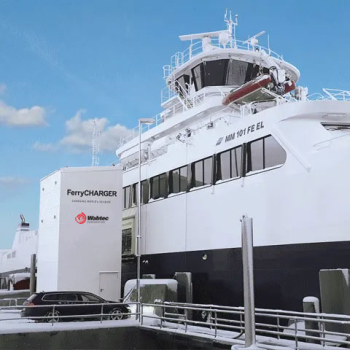
Wabtec FerryCHARGER

So, yes, while it’s fundamentally a ‘plug-and-socket’ problem writ large, it’s also an ergonomics, power conversion, safety, staffing, and sustainability challenge all wrapped up into one and set against a fickle and unpredictable ocean environment.

“And it’s not lost on port operators and local governments that it’s counterproductive for ports to pollute the environments which attracted cruise passengers in the first place,” observes Kompaore.

At the Port of Kiel, ShoreCONNECT has reduced annual CO2 emissions by 12,000 tons, which is one reason the solution is growing in prevalence across Europe’s, and the world’s, most iconic ports, including Barcelona, Bremerhaven, Naples, Nassau, and Venice. And today in Rostock, Germany, Wabtec’s solution stands alone as the largest shore power plant in all of Europe, capable of supplying up to 20 MVA to two cruise ships simultaneously.

Fast-charging for ferries

Charging an electric ferry poses a different challenge. The growing fleet of RoPax/RoRo (roll on, roll off) electric vessels needs electrons fast! That’s because they, like the passengers and vehicles they service, are always on the go. One group of passengers exits, another quickly comes onboard. Next!

By necessity, this energy exchange is a pit stop, a quick turn.

And to make it happen, Wabtec has stepped up the automation, developing a specialized power-transfer solution for the job, FerryCHARGER.

图像
Wabtec FerryCHARGER

“Because this solution hinges on rapid charging, it is highly automated and very futuristic,” highlights Julian Elskamp, FerryCHARGER engineering lead. “When the ferry approaches the terminal, the ferry charger receives a wi-fi signal that readies it for action. Then, as the ferry docks, our system automatically detects the socket, connects to it, and commences charging – all in 10 seconds or less. When the charge completes, the system automatically detaches, and the ferry is free to go.”

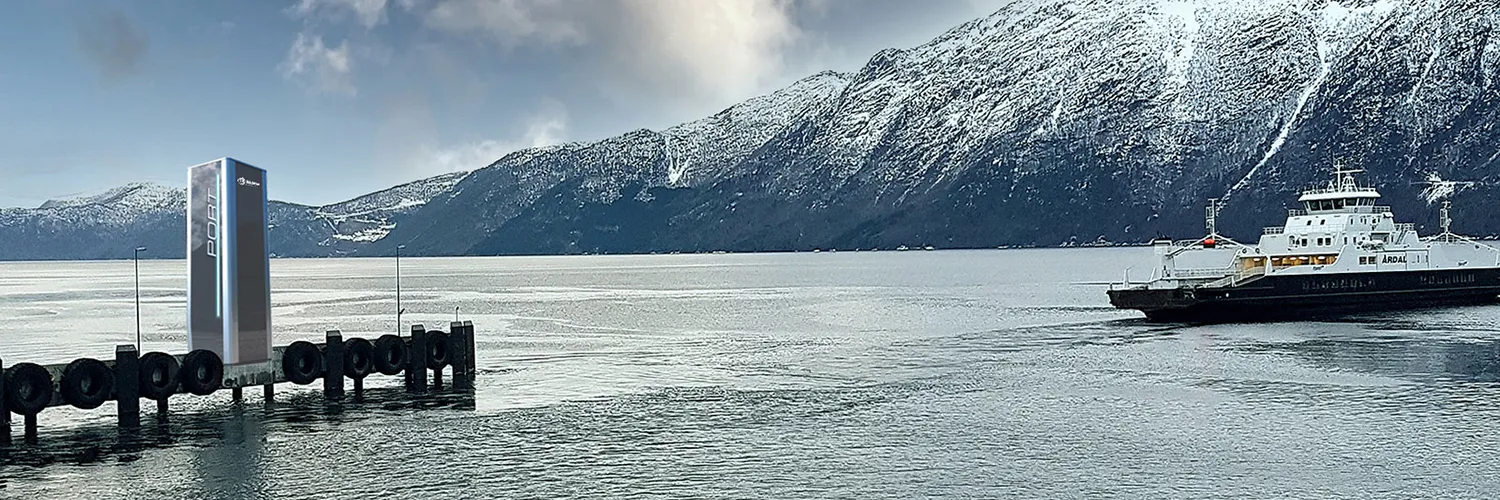
The system’s ability to transfer a large amount of power quickly and reliably in a fully automated fashion is making it a mainstay at ferry terminals around the world. FerryCHARGER is a hit on the Casco Bay Lines in Portland, Maine, and was recently selected by Washington State Ferries – the largest ferry system in the U.S. – to provide automated charging systems for its new hybrid electric ferries.

All of which is old news to ports in other parts of the world, including those in the Nordic region and Canada, which have been using FerryCHARGER to support ferry electrification and the shift to green transport, cutting emissions by up to 75%.

Clear sailing ahead

At home in the port environment, Wabtec is finding success with its customers across charging form factors and use cases.

“No two ports are alike,” concludes Kompaore. “That’s where our long history as a trusted solution provider helps us. We have an extensive track record of power-transfer innovation and versatility that is second to none in this space. Whatever the challenge, our port customers know we are on this journey with them and safe passage lies ahead.”

图像
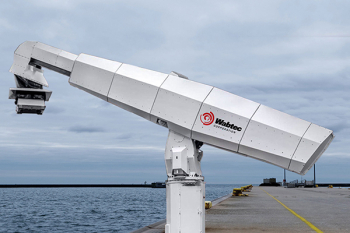
Wabtec Onshore Power Supply

1 The International Marine Organization (IMO) targets net zero emissions by 2025, with 20-30% reductions by 2030. “EU Fit for 55” mandates that by 2030 all container and passenger ships over 5,000 GT must connect to onshore power when staying more than two hours in major EU ports.

Browse more from
Trains of Thought