
Happy 100th Anniversary, Lawrence Park
The Township that Powered a Century of Wabtec Innovation
The town would be called Lawrence Park, a tribute to Captain James Lawrence. Lawrence was a War of 1812 hero, famous for his naval battle command, “Don’t give up the ship!” Construction began in 1911. The first streets were named for famous scientists, inventors, and engineers. Rankine. Silliman. Smithson. Morse.
--from The Lawrence Park Origin Story
Betting big on Erie
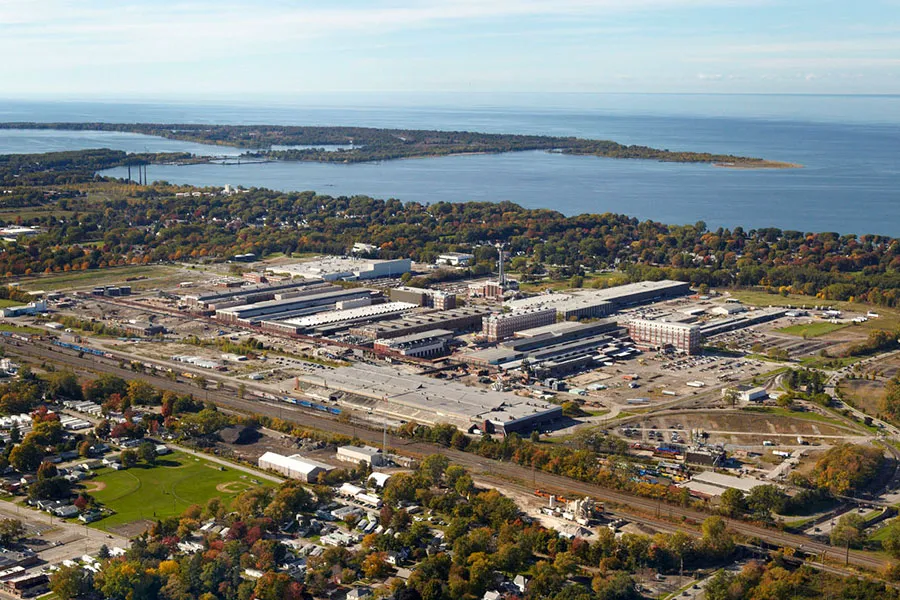
In 1907, The General Electric Company made a big bet, placing its chips on Erie, PA as the centerpiece of its Midwest expansion. That bet would pay off handsomely – for the company (now Wabtec), for its workers, for the local community, and for the future of rail – as it set in motion one of the greatest engineering, innovation, and productivity triumphs in the history of American manufacturing.
The smart money had been on Cleveland or Buffalo. But when Francis Pratt set out to scout locales for a new GE engineering and manufacturing center – the company’s Schenectady, NY headquarters and Lynne, MA plants had grown to full capacity – he took a quick diversion to Erie to meet an old Yale pal and local manufacturing magnate, Matthew Griswold, Jr.
Upon learning of his friend’s mission, Griswold turned on the charm and opened Pratt’s eyes to the possibilities of Erie: undeveloped, affordable land in abundance; easy access to a vital port and railway lines; and a local population that knew how to work, and work hard.
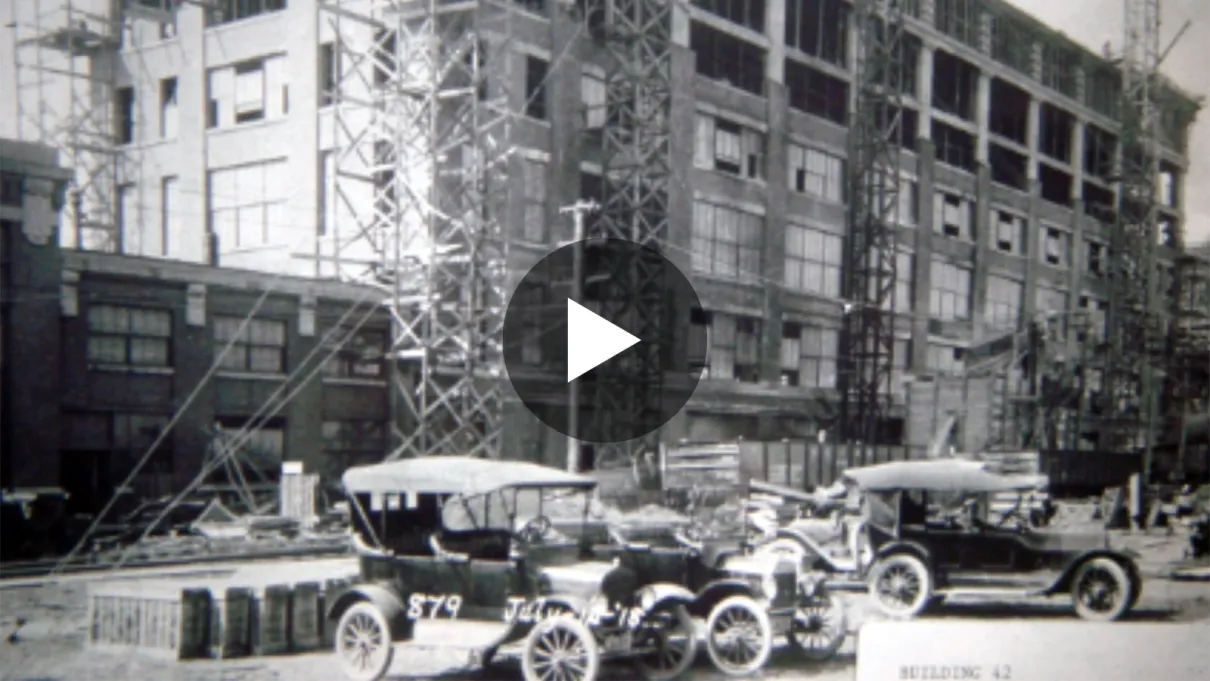
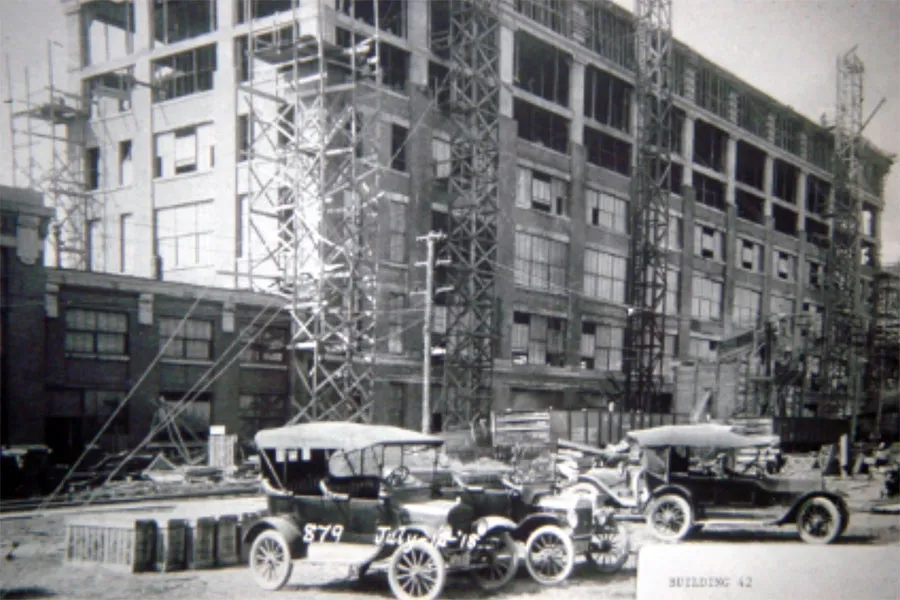
The seed was planted, and GE pivoted, buying the land it needed in Erie and planning its factory build. But even as the blueprints for the Erie Works were being drafted, and ground broken on the site’s first buildings (Building 10 and 18), another kind of development – one understood as vital to this enterprise’s success – was set in motion: a place for the plant’s workers to live, Lawrence Park.
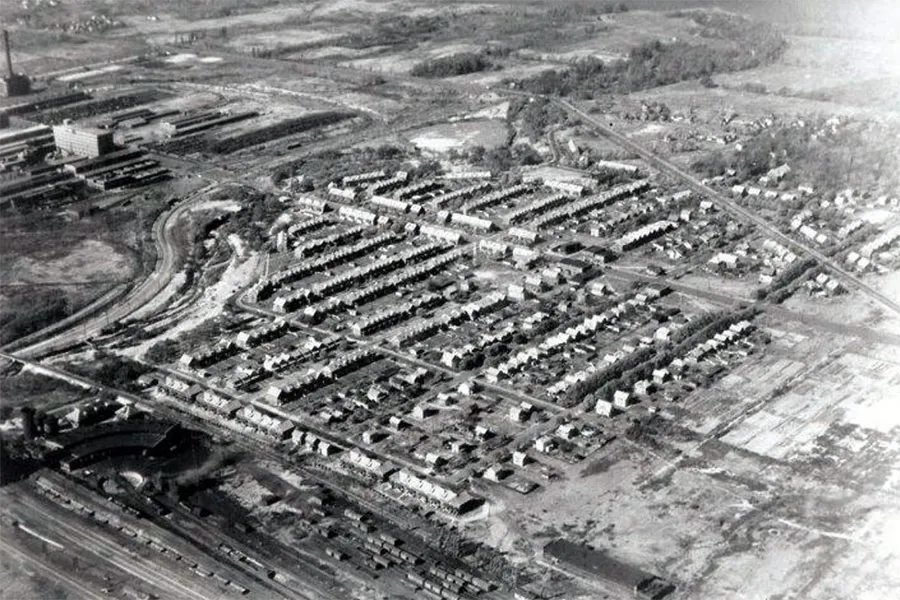
And it wouldn’t do for Lawrence Park to be ordinary – it would be a “Garden City,”1 one with housing available for every type of worker and pay grade; modern amenities, such as central heat, power, and sanitation; streetlights, sidewalks, and green space in abundance – both in the form of front lawns and backyard garden plots, as well as public parks. All within walking distance or an easy trolley ride to work.
“It’s essential to understand that as The General Electric Company was breaking ground on its manufacturing campus it was also seeking to provide thoughtfully planned housing and amenities for its expanding workforce,” says Anna Mae Van Dyne, President, Lawrence Park Historical Society. “With its tree-lined streets, access to green spaces, and cohesive architectural design, Lawrence Park would quickly gain national attention as a model industrial village and planned suburban community.”
Growth spurt: Supporting the war effort
With blueprints drawn and ground broken, the intertwined histories of the Erie plant and Lawrence Park community switched into high gear, in no small part due to World War I.
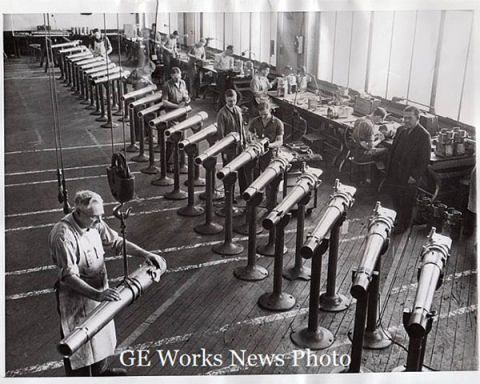
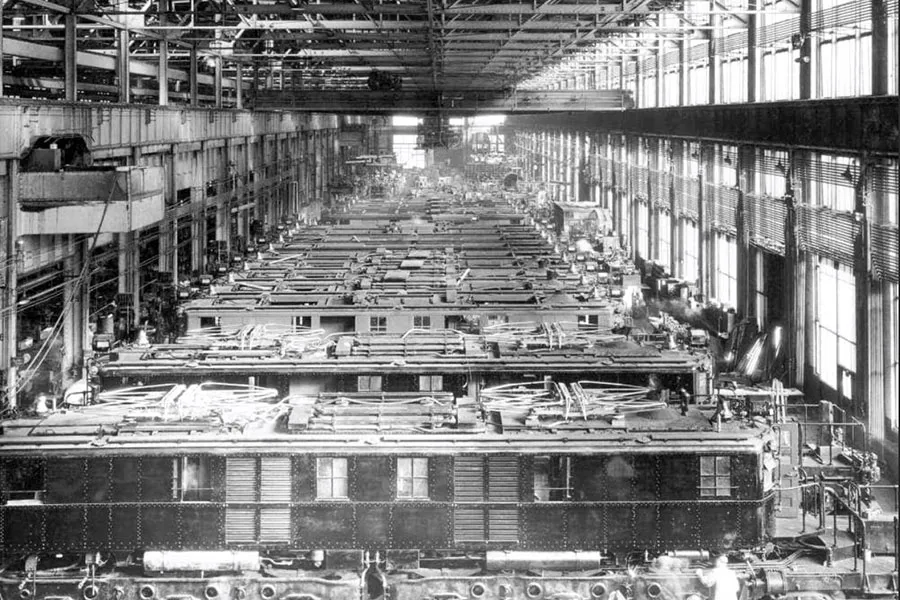
By the time of the War, the Erie facility was already a prolific foundry (maker of metal castings) and had made advances in gasoline engine production and gas-electric railcar assembly and locomotive manufacturing. In 1914, the company began manufacturing additional castings, artillery shells, and ship turbines to support the Allied war effort, then, in 1917, America’s, as it entered the war.
And with all this additional manufacturing, the employee population swelled, as did that of Lawrence Park.
The die had been cast. The model was working. So much so that in 1926, Lawrence Park Township was officially incorporated as a “First-Class Township,” the only such designation in Erie County, and one that would protect the budding township from annexation and deepen the link between GE and the local community.
Named after Captain James Lawrence, a War of 1812 hero famous for his naval battle command, “Don’t give up the ship!,” Lawrence Park was now poised to power a new era in rail, while providing a warm and vital community for the workers – and their growing families – who were making it happen.
Full speed ahead: A century of rail innovation
In the hundred years since, the trail of engineering and manufacturing innovation blazed by the Erie plant together with the people of Lawrence Park has been nothing less than extraordinary.
“The Erie plant and workers of Lawrence Park have been at the heart of locomotive innovation and manufacturing for more than a century,” remarks Jim Meyer, Chief Engineer and Chief System Architect at Wabtec, a 38-year veteran of the company, 28 of which have been served in Erie. “That innovation has evolved right alongside the rail industry itself, starting first with Edison’s electric locomotive designs and successfully pivoting to locomotive products with internal combustion engines, as dictated by the market.”
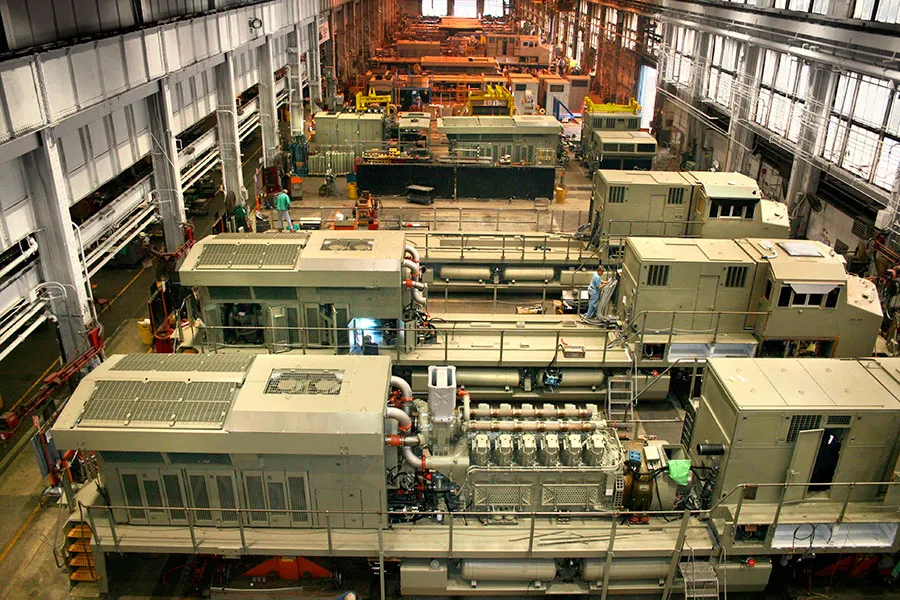
These diesel locomotives would ultimately become the standard bearer of Wabtec, and the entire rail industry, with Erie serving as their launchpad:
- The Universal Series (1955-1976)
- Dash 7 (1977-1985)
- Dash 8 (1985-1994)
- Dash 9 (1994-2004)
- AC4400/6000 (1994-2004)
- PowerHaul (2009-2016)
- Evolution Series (2002-present)
- FLXdrive Battery (2020-present)
“Some of these designs were truly transformational for the industry,” continues Meyer. “For example, Dash 8 locomotives were designed with advanced electronic controls – technology that fundamentally improved how locomotives were operated and maintained. Also, Erie played a major role in the industry’s transition for DC to AC traction, which significantly improved performance, reliability, and hauling capability.”
With almost too many Erie-born breakthroughs to count, Meyer credits a special camaraderie rooted in shared goals and community, as well as an unselfish dedication to customer success, for the plant’s ongoing vitality.
“What ties all of this together is a deeply customer-centric approach,” assesses Meyer. “These breakthroughs didn’t happen in isolation, they came from close collaboration among engineers, manufacturing, supply-chain teams, and our customers. Erie has always been about listening, adapting, and turning real-world needs into real-world solutions.”
Community spirit and investment
And whether the Erie plant was producing war munitions, refrigerators, mining systems, transit cars, or next-generation locomotives for a growing global audience, Lawrence Park was always there, a co-creator in excellence.
“The symbiosis between GE, Wabtec, and the town has always been special: the company and the town are cut from the same cloth,” reflects Jaye Beebe, Treasurer, Lawrence Park Historical Society. “GE literally built the town, and along the way infused it with great schools, an apprenticeship program that was a gateway to a meaningful career for so many, and a strong police and fire department. Beyond these key foundational elements, the company sponsored night classes, arts and entertainment, local youth sports teams, and special events for kids.
“There isn’t a person in Lawrence Park who doesn’t remember the Halloween and Christmas celebrations funded by the company, a tradition that continues to this day.”
And new traditions carry the torch of community spirit and connection forward. Bids for Kids, Wabtec’s signature fundraising event in Erie, has raised millions of dollars for local agencies, including Boys & Girls Club, Make a Wish Foundation, Shriners Children’s, and UPMC Children’s Hospital of Pittsburgh, while programs like the Wabtec STEAM (science, technology, engineering, arts, and math) Fair spark the imaginations of future innovators.
Meyer, who Co-Chairs Bids for Kids, sees these programs as a life-changing legacy that epitomizes the compact between the company and Lawrence Park:
“These programs aren’t related to production or business results – they’re about supporting education, curiosity, and long-term growth in the region. Along with partnerships such as ones with United Way, Edison Elementary School, and the Wabtec Girls collaboration with Penn State Behrend, these efforts help ensure the community remains strong and sustainable.
“These programs aren’t charity; they’re investments. They reflect a long-standing belief that when the community thrives, everyone benefits – including the company.”
A palpable past, an impactful future
“So many people who live in Lawrence Park have worked at Wabtec or know someone who does or did, including parents, grandparents, uncles, aunts, and siblings,” observes Van Dyne. “Plant workers married, had families, and saw their children work at the plant, writing their own part of the company’s history and the town’s.”
Meyer hears this in the pride of retired workers at the VFW Hall, regaling each other with stories of the locomotives they built – “my locomotives” – and the buildings in which they built them, like Building 10, whose mere mention conjures reverence often reserved for storied sporting grounds such as Lambeau Field.
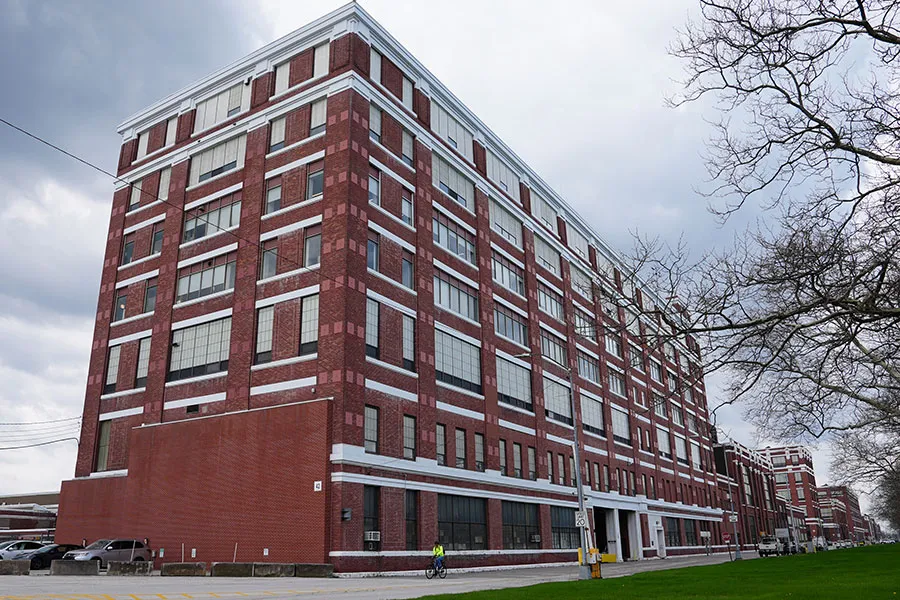
“The buildings at the Erie plant aren’t just physical spaces, they’re milestones in the plant’s history,” offers Meyer. “The numbers on the doors haven’t changed, but what happens inside those walls has continually evolved as technology and customers’ needs evolved.
“Building 10 is probably the most iconic. For generations, it has been at the heart of final locomotive assembly – where thousands of locomotives came together and rolled out to serve railroads across the world. For many employees, simply hearing ‘Building 10’ immediately brings back memories of the programs, the people, and the pride that went into that work.”
For Meyer and the many Lawrence Park residents and Wabtec employees who measure their commitment to their customers, company, and craft in decades and generations, this connection to place and dedication to quality is now a part of their DNA.
“Wabtec and Lawrence Park grew up together – quite literally,” summarizes Meyer. “From the earliest days, the company depended on this community and, in turn, invested in it. That belief still guides how we operate today. Ultimately, the company didn’t just build locomotives here, it helped build a town. That legacy of shared growth and long-term commitment is something we intend to carry forward. After 100 years, the story here isn’t ending. As it has from the beginning, it is continuing to evolve.
“As long as we can rally as a team and solve tough problems, we’re going to have customers. And as long as we have customers, we are going to have opportunities to show what Erie and Lawrence Park are made of.”
Happy Centennial, Lawrence Park. Wabtec would not be where it is without you.
###
For more information about the Lawrence Park Centennial, including a calendar of the year’s celebratory events, please see: https://www.lp100years.com/contact-us.
1A self-contained community designed to combine the benefits of city living with the natural beauty of the countryside. Concept developed by Ebenezer Howard; first introduced in Europe at the turn of the 19th century.