
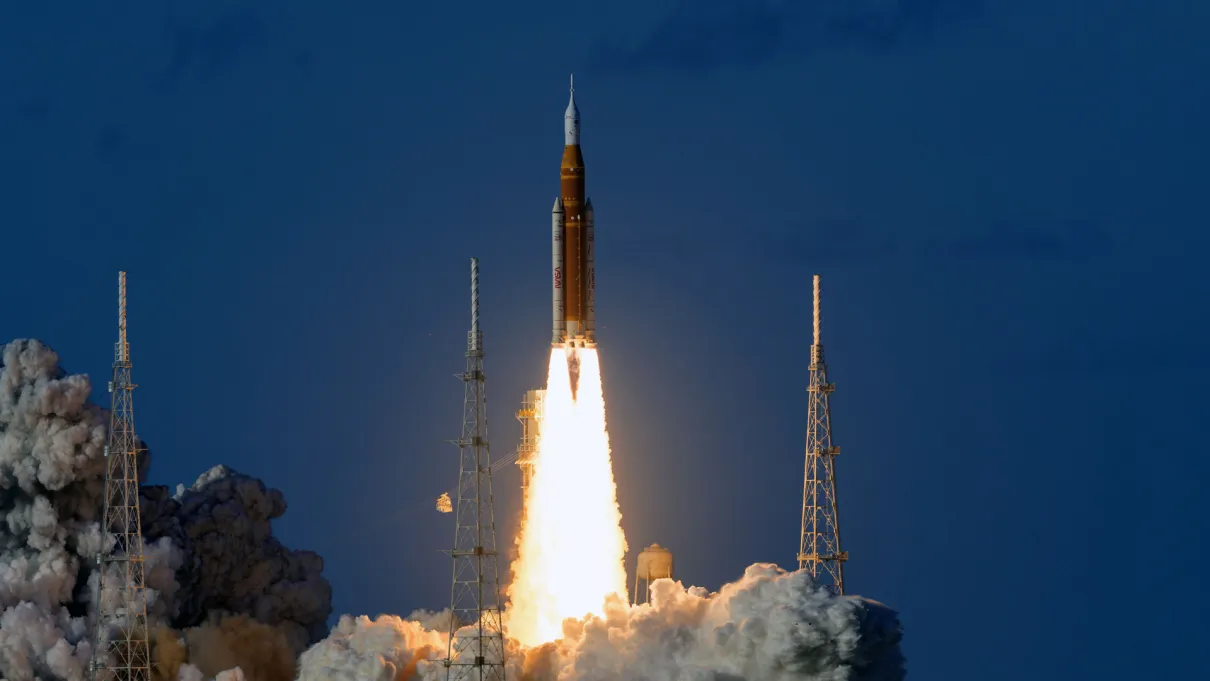
Photo Credit: NASA/Bill Ingalls
Upon Closer Inspection: Wabtec, Artemis II, and the New Space Race
Disclaimer: NASA is not affiliated with Wabtec and does not endorse Wabtec or its products or services. All NASA and other third-party names and trademarks are the property of their respective owners and are used for identification purposes only.
Liftoff
On April 1, 2026, at 6:24 p.m. EDT, the Orion spacecraft, powered by the 322-foot Space Launch System (SLS) rocket, took off from Launch Complex 39B at NASA’s Kennedy Space Center for a 10-day journey into history.
Artemis II, the first crewed “lunar flyby” mission in over 50 years1, had begun. The Artemis program, named after the Greek goddess of the wilderness, hunt, and Moon (and twin sister of Apollo), is NASA’s initiative to return astronauts to the Moon and to build a foundation for the first crewed missions to Mars.
But first things first.
Artemis II builds on the success of Artemis I, which launched on November 16, 2022, and demonstrated the capabilities of the new SLS rocket and space capsule while completing a successful, unmanned trip around the Moon and a safe splashdown 25 days later in the Pacific Ocean.
With Artemis II, the stakes were even higher, sending four crew farther into space than any human has ever traveled2 —4,070 miles beyond the Moon, or approximately 250,000 miles from Earth—affording views of the “far side of the Moon” never before seen by the naked eye.
But the crew had more to do than simply sightsee: its mission was to test new systems and hardware, setting the stage for future expeditions to the Moon’s surface, including Artemis IV, a crewed landing mission planned for early 2028. (Note: Artemis III’s mid-2027 destination is a bit closer to home—a low Earth orbit mission testing commercial landers from SpaceX and Blue Origin to be used on Artemis IV).
One weld at a time
While the numbers associated with Artemis II and space travel are mind-blowing,
- 695,000 miles round trip
- Up to 5,000 °F— The temperature Orion’s heat shield is designed to withstand upon reentry into Earth’s atmosphere (approximately half the temperature of the Sun’s surface)
- 8.8 million pounds of thrust at liftoff,
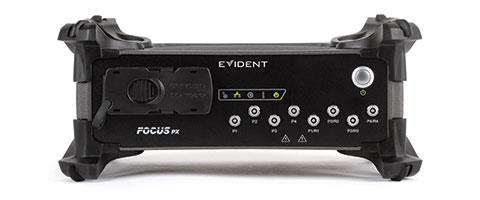
there’s one number in particular that has the full attention of Wabtec Inspection Technologies (Wabtec acquired Evident’s Inspection Technologies division, formerly part of the Scientific Solutions Division of Olympus Corporation, in 2025): 111,000.
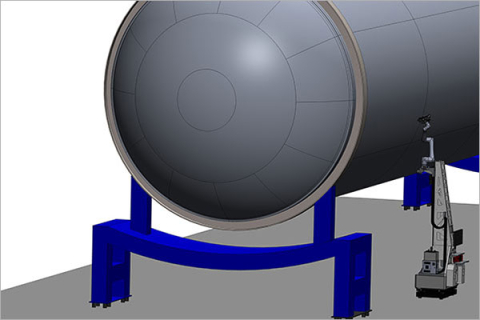
That’s how many inches of welds were involved in assembling the rocket’s fuel tanks—about 1.76 miles of welds in total. It was the job of ultrasonic phased array inspection systems to examine circumferential, longitudinal, and other weld orientations of welds on this rocket to ensure their integrity and, ultimately, the crew’s safety and mission’s success.
Detecting wormholes, kissing bonds, and root toe defects
These welds create joints that result in high-strength bonds. For example, the “friction stir weld” is used to join materials that are difficult to fusion weld, such as aluminum alloys, and is widely used in advanced aerospace manufacturing.
On the Artemis II rocket, dozens of panels needed to be joined using this method. While superior for the task at hand, these welds introduce a unique set of potential defects, including incomplete joint penetration, “wormholes,” “kissing bonds,” and “root toe defects” (see “Autonomous Friction Stir Welding Inspection in Aerospace Production” in Inspection Trends magazine).
This advanced welding process, although known to be highly robust, can introduce anomalies oriented in any direction, making the inspection procedure more complex and critical. In short, these welds require a specialized nondestructive testing approach and technology, one the team has helped to advance for industrial applications: phased array ultrasonic testing (PAUT).
For those not familiar with this terminology, the American Society for Nondestructive Testing describes the technology as follows:
"Ultrasonic phased array (PA) testing uses multiple ultrasonic elements and electronic time delays to generate and receive ultrasound, creating beams by constructive and destructive interference. As such, PA offers significant technical advantages over conventional single-probe UT: the phased array beams can be steered, scanned, swept, and focused electronically”.
Originally developed in the 1960s for medical applications, including sonography, this technology has since become a mainstay for performing difficult inspections on mission-critical assets in the oil and gas and aerospace industries.
“Our Nondestructive Testing (NDT) solutions, those capable of performing advanced inspections, come in many form factors, from handhelds for manual use to fully automated robotic cells, and are in widespread use across industries,” says Karen Smith, Senior Vice President, Wabtec Inspection Technologies. “Specifically, in aerospace, they have become an industry standard and are ubiquitous across the operations of market leaders.”
These inspection technologies have even been used in space. When an above-tolerance air leak was detected on the International Space Station, portable inspection tools enabled a crew to quickly pinpoint the problem and fix it.
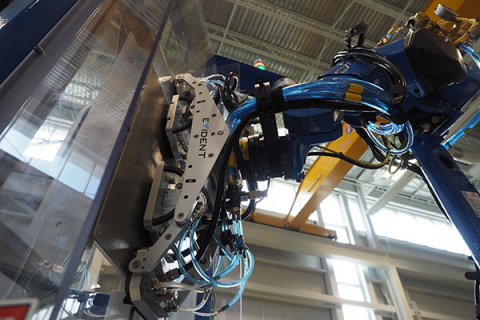
“We’re collaborating with our aerospace customers in a number of meaningful ways, each of which is grounded in a shared mission of safety,” says Dusty Moore, Americas Vice President of Sales for Wabtec Inspection Technologies. He adds, “Whether our customers are sending a portable NDT flaw detector to outer space, running a small-diameter borescope into an engine, or employing a robotic cell to test panel welds, our technology is inspecting what needs to be inspected, where it needs to be inspected, to ensure success.
“The Artemis program is a powerful proof point, showcasing the flexibility and precision of our solutions. Not only is our ultrasonic technology performing friction stir weld inspections at scale, but also our eddy current and remote visual technologies are contributing to the safety and performance of the Artemis II craft.”
And that’s what counts most: doing the small things right, sometimes inch by inch, to make moonshots not only possible but repeatable— safe foundations from which to launch even more ambitious plans for the future.
1 The last crewed lunar mission was Apollo 17 in December 1972 (source: Florida Today)
2 Source: NASA