この Web サイトは Internet Explorer ウェブブラウザをサポートしなくなりました。
マイクロソフトは廃止され、Internet Explorer もサポートされなくなります。この Web サイトにアクセスするには、別の Web ブラウザーを使用してください。
お使いのブラウザは最新の機能をサポートしておらず、一部の機能が正しく動作しない可能性があります。快適にご利用いただくには、アップデートしてください。
by David Eldredge, Adam Franco, Joseph Nazareth, William Schoonmaker, and Kiron Viegas
Fuel is a major factor in railroad operations, comprising, on average, 15-20% of operating expenses and 90% of greenhouse gas emissions. So, when railroads consume less fuel, it’s a win-win for the railroad and the environment: lower operating costs and reduced carbon emissions.
Today, rail is the most energy-efficient and cost-effective mode to move freight. Efficiencies have been growing across the industry for decades. In 1980, U.S. Class 1 trains, on average, moved a ton of freight 235 miles per gallon of fuel. Today, that distance has more than doubled to 489 miles on a single gallon1.
So, what is next? How do railroads take fuel optimization to the next level? How can every train be the most efficient? The answer lies in the factors that impact fuel utilization.
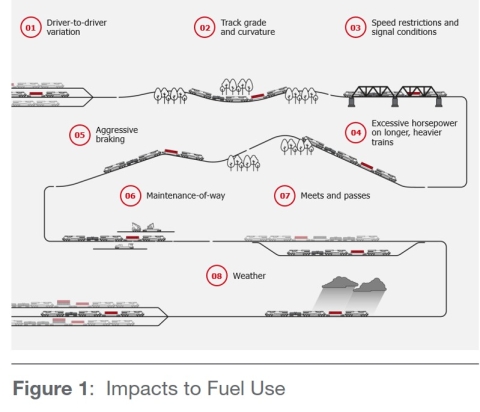
Every mission has a host of variables that impact fuel efficiency:
And all of this is against the backdrop of a constantly changing environment. The challenge in delivering next-level sustainability outcomes is not only in managing the variables that impact fuel use, but doing so consistently and at scale.
Digital technology is the enabler to solving these challenges and unlocking the full potential of efficient and sustainable freight rail. Through data, physics, algorithms, and machine learning, Wabtec can make locomotives smarter, trains more efficient, and networks more fluid.
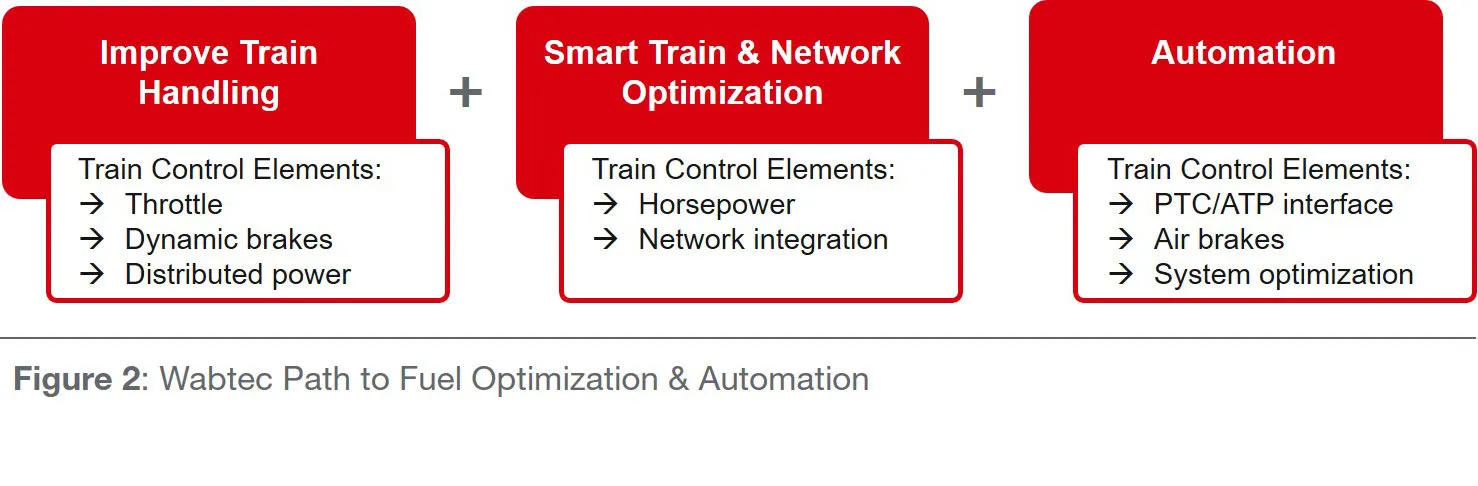
To help railroads realize the benefits of fuel optimization through digital solutions, Wabtec developed a framework that enables a phased approach with sequential steps. Each phase chronologically aligns to factors that impact fuel utilization with clear tactical goals. A key advantage is that railroads can jump in at any step and drive immediate incremental improvements, minimizing risk and ensuring return on investment. Ultimately, railroads can use this framework to map out a strategy to achieve the highest levels of fuel optimization and automation.
To meet the demand for longer, heavier trains — and provide efficient train handling — advanced distributed power systems enable remote control of locomotives in separate consists from the lead locomotive. Wabtec’s LOCOTROL® Distributed Power System is a proven control and communication system that enables coordinated braking and traction power distribution between lead and remote locomotives—for improved fuel efficiency, increased hauling capacity, and reduced operating costs.
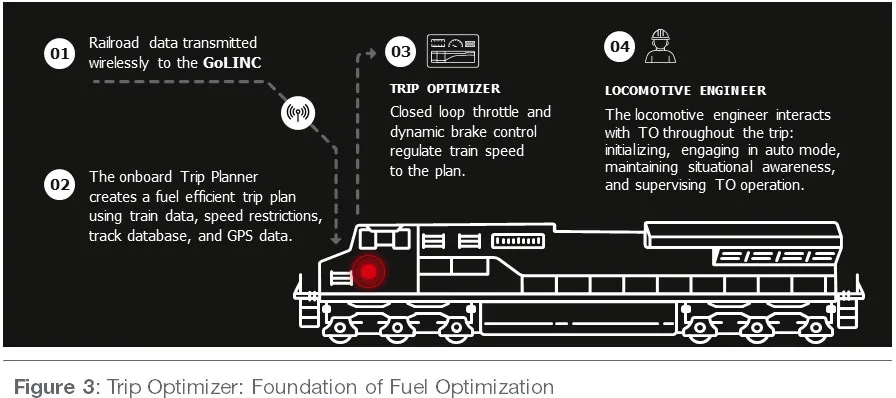
Cruise Control Energy Management: Trip Optimizer™ is the foundation of fuel optimization. Trip Optimizer allows drivers to achieve optimal fuel utilization by automatically controlling locomotive speed in real-time, reducing driver variability and increasing consistency. Trip Optimizer takes into account terrain, train make-up, speed restrictions and operating conditions to calculate an optimum speed profile. It automatically controls locomotive throttle and dynamic brakes to reduce fuel burn and provide efficient train handling. Trip Optimizer integrates with Distributed Power to further enhance train handling on longer, heavier trains.
Excess horsepower results in reduced fuel efficiency and increased greenhouse gas emissions. Traditionally, the process to determine horsepower per ton has been a manual process, resulting in wide variation in fuel efficiency across different trains. In addition, there was no way to control horsepower or isolate engines when a train had more locomotives than it needed for a given segment of its route. Trip Optimizer Smart HPT optimizes train performance by automatically reducing the horsepower per ton of the train without impacting velocity, driving incremental fuel savings.
Effective meet pass planning is one of the ways to manage slack time on the line, conserve fuel and improve the predictability of the train. The challenge is determining the speed profile and meet pass plan which optimizes performance and fuel savings across every train in the network simultaneously. Combining Trip Optimizer with Movement Planner allows for Pacing, which redistributes and optimizes the meet slack time on the line. Railroads that pace trains across the network achieve incremental fuel savings through reduced fuel burn en route.
The ability to create a trip plan based on PTC signals and restriction updates provides additional fuel savings. Trip Optimizer interfaced with PTC/ATP will increase Auto mile opportunities, enabling more fuel savings. Trip Optimizer with PTC Interface automatically adjusts to real-time network changes based on signal and speed restriction updates. Regulating speed to the PTC/ATP limits, Trip Optimizer stays engaged in Auto mode longer, resulting in higher fuel savings.
Increasing the envelope during which Trip Optimizer operates drives increased fuel savings. Trip Optimizer saves more fuel when it can be used in Auto Mode for a greater portion of the trip. The goal of Trip Optimizer Auto Air Brake Control is to increase the number of miles operated in Auto by:
Extending the envelope during which Trip Optimizer operates to 100% of Auto Miles enables maximum fuel efficiency.
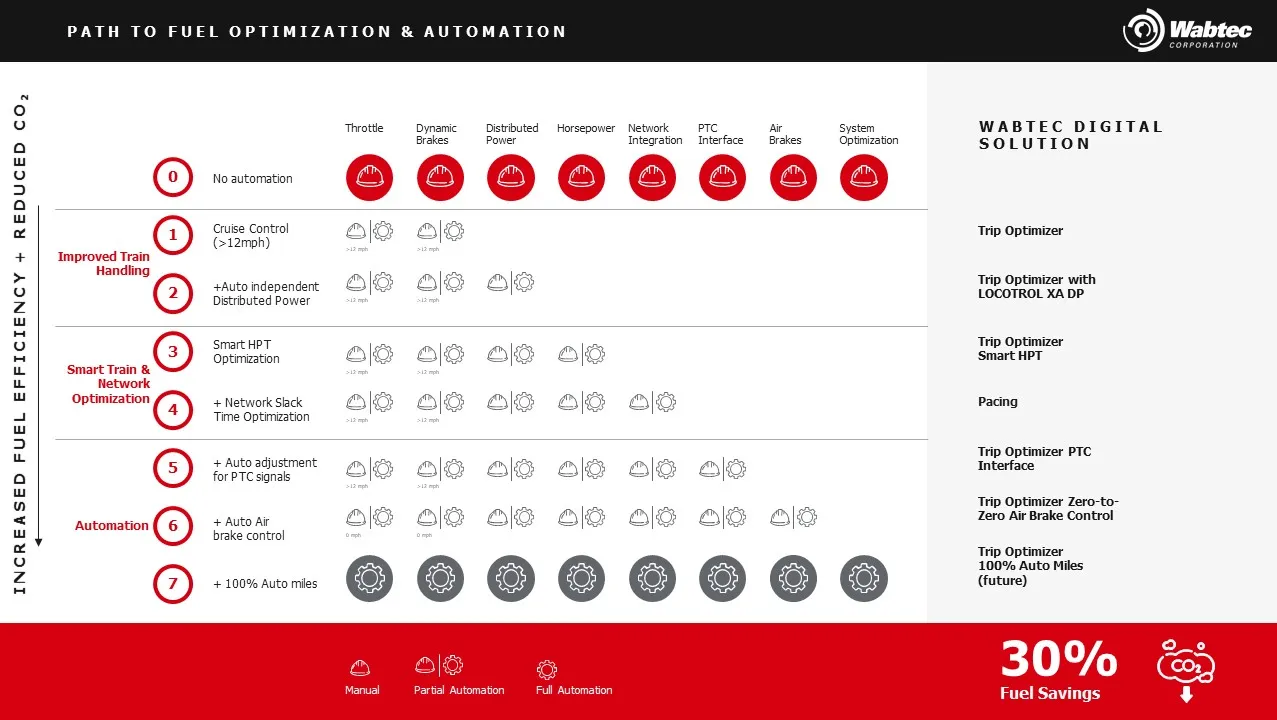
Wabtec’s Path to Fuel Optimization and Automation shows the framework for realizing maximum fuel efficiency through digital solutions. Built on a modular system architecture, it allows for phased integration of enhanced train control and automation solutions. This allows customers the ability to incrementally scale fuel savings to best meet their operational and sustainability environmental goals. (Figure 4)
Whether you’re just getting started or seeking additional efficiencies, Wabtec has an unparalleled portfolio of digital products that deliver fuel efficiency outcomes that matter.
Figure 4: Path to Fuel Optimization & Automation
About the Authors:
Dave Eldredge is the Product Line Leader at Wabtec for Trip Optimizer. He is responsible for development and commercialization of industry-leading energy management solutions. Dave has over 17 years of experience in Digital Electronics.
Adam Franco is the Senior Digital Product Manager for LOCOTROL, Distributed Power and Remote Control at Wabtec. He is currently focused on delivering higher level of operational efficiency and fuel efficiency through remote control and drone control.
Joseph Nazareth is the LOCOTROL Product Line Leader at Wabtec. Joe is passionate about developing remote control solutions that improve the productivity and efficiency of freight train operations and has over 20 years of experience in doing so.
William Schoonmaker is Product Manager at Wabtec. William has over 25 years of experience developing and implementing products for the control of freight trains including over 10 years working on Trip Optimizer.
Kiron Viegas is a Product Manager at Wabtec. Kiron has spent over 25 years in engineering and product management roles in the technology industry and is passionate about solving sustainability and automation challenges in freight rail operations.