
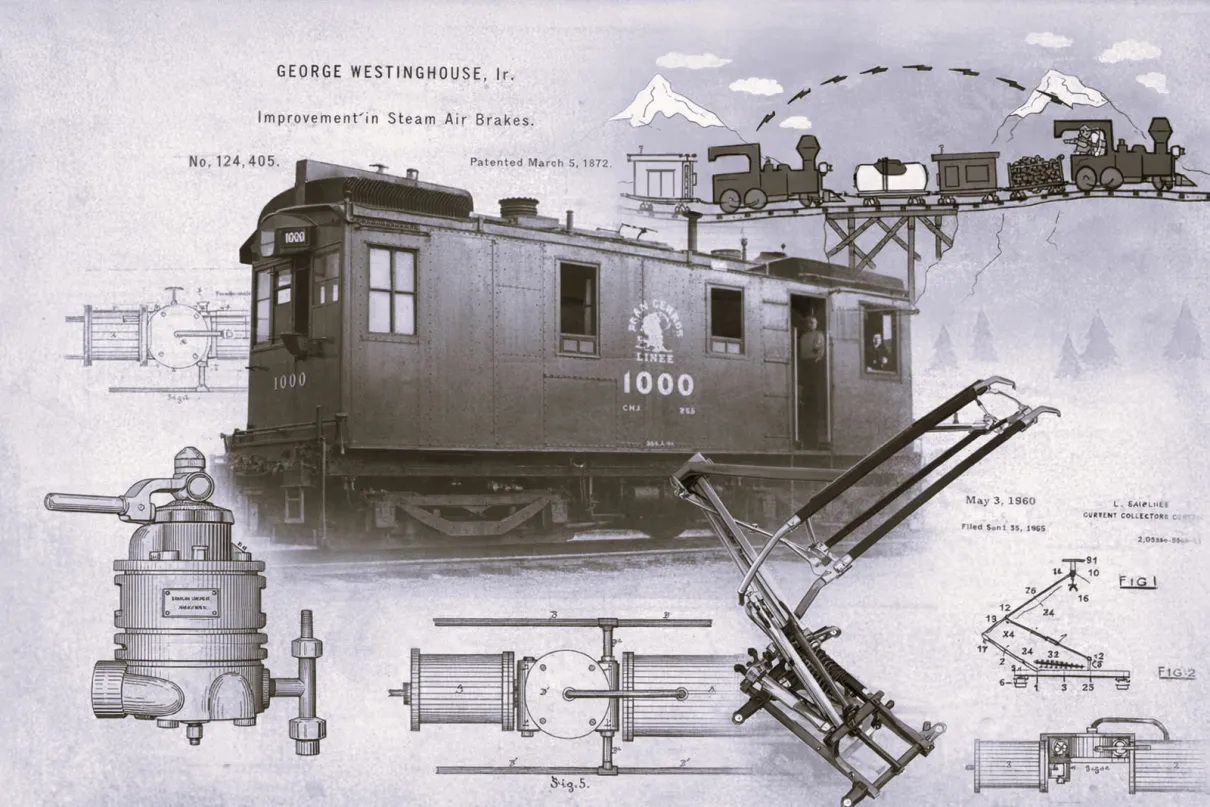
The Fab Four: The Wabtec Patents That Rocked The World
A 2026 Engineers Week Special
Wabtec is an engineering-centric company. It employs more than 4,700 engineers around the globe and holds over 6,500 active global patents (with recent acquisitions Dellner Couplers, Evident’s Inspection Technologies Division, and Frauscher Sensor Technology Group expected to add another ~1,000 to the fold) directed to innovations that make freight and transit rail safer and more reliable, efficient, and productive.
In celebration of the 75th anniversary of Engineers Week and the 250th anniversary of the United States, Wabtec salutes all engineers as it reflects on four of its biggest patents that permanently changed the rail industry – and the world.
A Note on Patents
But first, consider what it takes for new technology to be patentable. John Kramer, Senior Patent Counsel at Wabtec, offers these guiding principles: “For an invention to be legally patent-worthy, it must pass two primary criteria: ‘novelty’ and ‘non-obviousness.’”
To pass the novelty test, an invention must be at least incrementally different from what someone has developed in the past. Then, it must demonstrate there is enough of a delta between it and the prior standard that the change would not have been obvious to someone with “ordinary skill in the art.” Or, as the European legal community would frame it, the innovation needs to have involved an “inventive step.”
We think you’ll agree the following four Wabtec inventions more than pass the test.
1. The Diesel-Electric Locomotive: US Patent No. 1,589,182
The thought that the diesel-electric locomotive, developed by General Electric (now Wabtec) in partnership with Ingersoll-Rand and the American Locomotive Company, would not only displace the steam locomotive, but also become the industry standard over the past 100 years, was not likely anticipated.
Except, perhaps, by Thomas Edison.
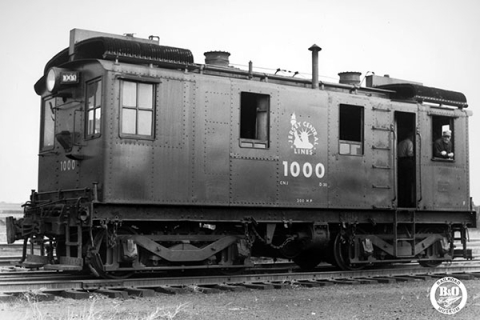
Edison had sensed electricity held possibilities steam could only dream of as early as the 1860s and began his pioneering work on all-electric trains later in Menlo Park, NJ in 1880. Yet it wasn’t until the emergence of Nicolaus Otto’s internal combustion engine (ICE; invented in 1876) as an industrial application in the late 19th and early 20th centuries – one that transformed the automotive, aviation, and shipping industries – that the idea of combining an ICE and electric propulsion system in a locomotive took hold.
The timing couldn’t have been more fortuitous. Steam locomotives had their challenges. They relied on coal, which made them fundamentally dirty. They required manpower to shovel coal from the tender into the locomotive firebox. And the only way to make steam-driven trains faster was to build larger and larger locomotives, which were in turn limited by rail infrastructure, as the entire system, not just the boiler, was forced to grow.
Edison saw an opportunity for step-change improvement, and in 1925, General Electric and its partners pounced. The diesel-electric engine was born.
“Edison had always been intent on offering railroads a cleaner, more economical alternative to steam,” says Steve Gerbracht, Director, Locomotive Architecture and Concept Development at Wabtec. “As the industrial uses of internal combustion engines took off, the light bulb literally turned on at GE that the locomotive, independent of catenary lines and third rails, could house its own power plant.
“Then, through the use of an alternator, the mechanical energy generated by the ICE – in this case a diesel engine – could be converted to electrical energy that could drive the traction motors on the locomotive’s wheels. This marriage of the internal combustion engine with Edison’s arsenal of electrical components and propulsion equipment literally changed locomotive history and remains the standard upon which we at Wabtec, and the industry at large, continue to innovate.”
Eric Gebhardt, Executive Vice President and Chief Technology Officer at Wabtec, adds, “Edison’s breakthrough with the diesel-electric engine is the epitome of ‘system thinking.’ He and his team didn’t just look at improving the engine, they reimagined it, including what it could power, and how. This more holistic, system-oriented approach to problem solving is at the heart of Wabtec’s landmark patents and in the DNA of our engineering culture.”
2. The Air Brake: US Patent No. 124,405
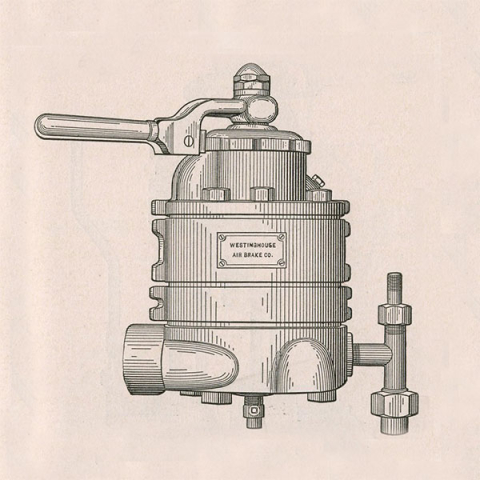
Prior to the air brake, the state of the art for stopping a train was for “brakemen” to traverse the length of the train and individually activate the brakes on every car while the train was moving. This task was extremely dangerous work and limited the ability to increase the length of a train.
Wabtec’s founder, George Westinghouse, was the right man for the job.
Inspired by an article spotlighting the use of a pneumatic drill for the digging of a tunnel in France, a process which required pumping compressed air through some 3,000 feet of piping, Westinghouse hatched a plan to use air to power brakes on a train.
His original patent for the air brake, No. 88929, issued on April 13, 1869, featured a steam-powered air compressor on the locomotive that pumped pressurized air through a network of hoses leading to brake cylinders on each car. The system, when activated by the train’s engineer, effectively applied the brakes the entire length of the train.
Just three years later, Westinghouse further improved his design, adding a “triple valve” and “auxiliary reservoir” to create the first large-scale fail safe system. In effect, the engineer could still control braking as usual, but with one key difference: now the system used air pressure to keep the brakes off. And, if a coupling broke or a hose ruptured, the loss in pressure triggered the instant application of brakes on all cars, stopping the train.
“The foresight of this system is absolutely amazing,” remarks Gebhardt. “Looking at these patents from over 150 years ago makes one realize we still do air braking with pneumatic brakes very similarly to how George Westinghouse initially planned it. And by creating this template for how to stop a train, he also played an instrumental role in enabling trains to grow longer, and therefore more productive.”
3. The Single-Arm Pantograph: US Patent No. 2,935,576
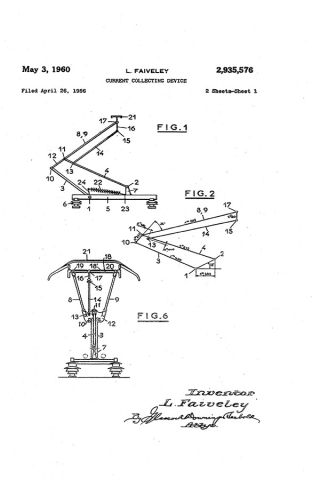
Wabtec co-founder Louis Faiveley didn’t invent the pantograph – he just made it unrecognizably better.
The double-arm, diamond-shape pantographs of the early-to-mid 20th century matched the rigidity and voltages of that era’s overhead wires. Yet their bulkiness and heavy mass wasn’t conducive to the higher voltages and higher speeds that beckoned.
Faiveley seized the opportunity to develop a new and better kind of pantograph, breaking the mold entirely with the invention of the single-arm pantograph (also known as the half-pantograph or Z-shaped pantograph). An engineering marvel, Faiveley’s elegant design was lighter, more aerodynamic, and ingeniously used naturally occurring “lift” from the air rushing past it to keep the panhead in constant contact with the wire. The new pantograph went on to set the world speed record (331 kmh/206 mph) for an electric powered train the same year it was introduced, 1955, and is the industry standard to this day.
And with ongoing innovation to the single-arm pantograph, more record-breaking performances have followed. New Wabtec pantograph models, all indebted to Faiveley, enabled trains to top speeds of 515 kmh/320 mph and 574 kmh/356 mph in 1990 and 2007, respectively. Beyond setting new speed records, Wabtec pantographs achieved many firsts throughout the 20th and 21st centuries, spanning innovations in material design, footprint size, rooftop integration, arm reach, and power modes, contributing to a pantograph proliferation that exceeds 150 types and more than 90,000 installed worldwide.
“Faiveley’s visionary work unleashed a new age of high-speed rail that has transformed the transit industry, and with it the lives of millions of travelers,” admires Matt Atkins, Power Collection Engineering Director at Wabtec. “In the world of pantographs and high-speed trains, there is a clear ‘before and after’ marked by the year 1955.”
4. LOCOTROL® Distributed Power: US Patent No. 3,380,399
Fast forward to 1965. The rail industry was hungry for distributed power, a phenomenon intuitively understood by any child who has strung car after car together on a model train set. At a certain point, when the train becomes too long, it wants to split apart.
The solution? Adding more locomotives.
But where to put them?
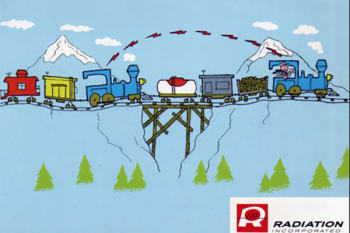
While stacking them up front might have been easiest, such a configuration of heavy locomotives would have put too much stress on the existing rail infrastructure, including bridges (see diagram), and the trains couplers and drawbars. Solving for this first “use case,” LOCOTROL® was born.
LOCOTROL® represents the control and communication system breakthrough that enables a trailing, unmanned locomotive consist, wherever it is positioned, to follow the orders of the lead locomotive. So, if the operator is putting the locomotive into notch four of traction control, that notch-four command is transmitted to the locomotive(s) placed at the middle or rear of the train.
“The early versions of LOCOTROL® are analogous to the early days of supercomputers,” observes Danny Rush, Vice President, Engineering at Wabtec. “It took an entire freight car of RFID and computing equipment to perform ‘remote control’ commands from the front of the train to the back. By the 1990s, we got it down to about a bookshelf size of equipment, and then, with continuous advancements in microprocessors, the solution footprint has shrunk to a box about one-foot long.”
As computing power and communication networks have continued to evolve, so, too, have ambitions for LOCOTROL®, with rail operators around the world pushing the envelope on communicating commands not only between locomotives, which has enabled longer and longer trains, but also between locomotives and towers, and even from fully remote locations.
“The original patent for LOCOTROL® created the control and communication framework needed to enable safe distributed power on a train, which has issued in an era of longer and longer trains, and the productivity gains associated with them,” instructs Bob Palanti, Senior Architect, Train Handling at Wabtec. “But this watershed patent also set the stage for a revolution in automation, now 70 years in the making, that is spurring new operating models and driving new efficiencies. Wabtec and its customers aren’t done with LOCOTROL® yet – not even close.”
Conclusion
One sign of a successful patent is the amount of subsequent innovation it drives and inspires. These (FAB) four patents, with roots tracing as far back as the mid-1800s, not only transformed the rail industry over time, they became foundations upon which Wabtec engineers continue to innovate to this day.
“The thing each of these patents share is not only their incredible foresight, but their boldness. I mean 150, 100, and 50 years later, we are still very beholden to the original thinking behind these patents,” concludes Gebhardt. “Edison, Westinghouse, Faiveley, and others laid down a blueprint for all bright-minded and ambitious engineers to follow: Swing for the fences. Your ideas can change the world.”